Legal terms can feel confusing, especially when you hear phrases like second-degree murder in news, crime shows, or social media discussions. If you’re a student, true-crime fan, or someone trying to understand criminal law better, this guide breaks it down in simple language.
Here, you’ll learn what second-degree murder means, how it works, where it applies, and how it differs from other murder charges. By the end, you’ll understand this legal term without needing a law degree.
Definition & Meaning of Second-Degree Murder
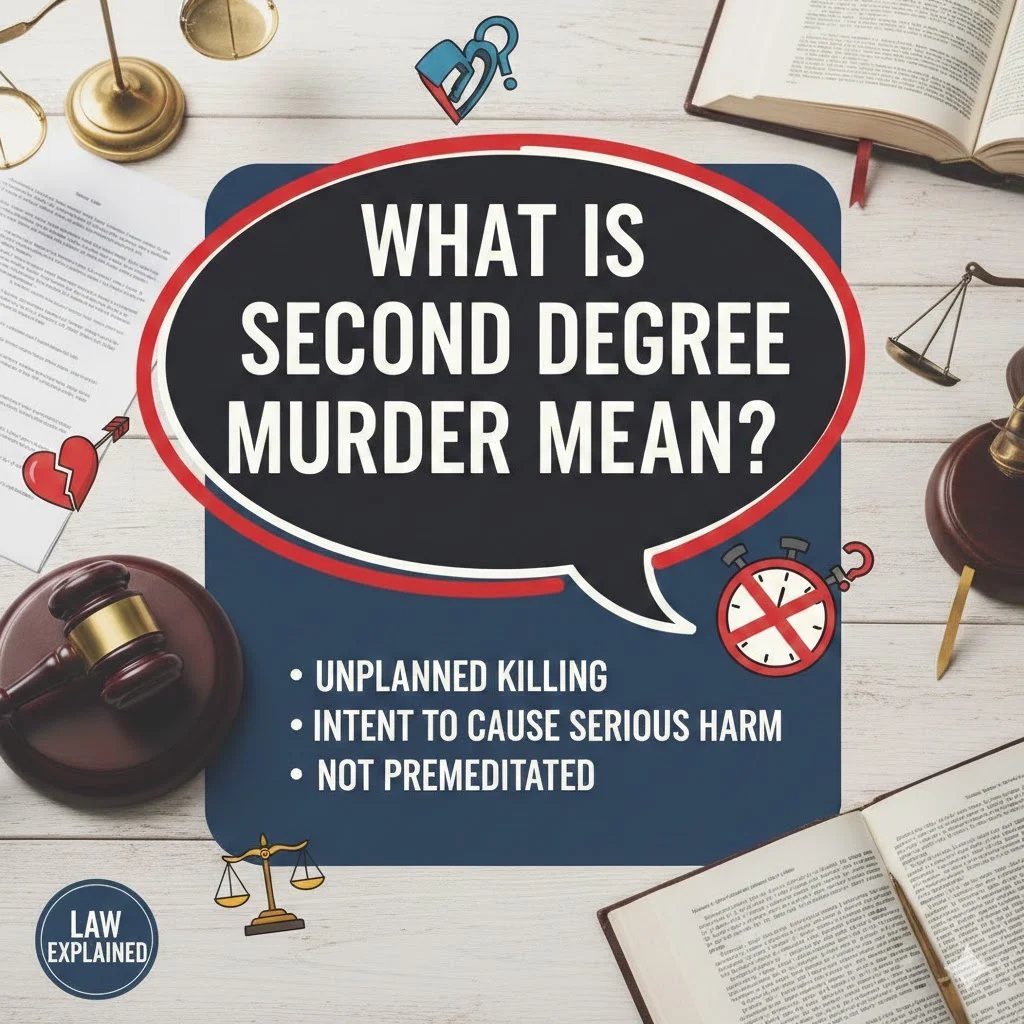
Second-degree murder is a serious crime. It happens when someone kills another person without planning it, but still has intent, malice, or knows their actions could cause death.
Key points:
- The killing is not planned.
- The person acts with malice—meaning they know their actions are dangerous.
- It is more serious than manslaughter, but less serious than first-degree murder.
Simple examples:
- A person gets angry during a fight and kills someone. They didn’t plan to kill, but acted with deadly intent.
- Someone fires a gun into a crowd “without caring who gets hurt.”
Short dialogue example:
Friend 1: “Is second-degree murder planned?”
Friend 2: “No. It’s intentional, but not planned.”
Background & History
The idea of second-degree murder comes from older legal systems that wanted to separate:
- planned killings
- emotional or impulsive killings
- accidental killings
Before these categories existed, all unlawful killings were treated the same. Over time, courts realized not all murders are equal. So the “degree system” was created to make punishments fairer.
Different countries and U.S. states use this system with small variations. Some places even have no second-degree category, while others define it very clearly in their criminal codes.
The main goal has always been to judge each killing by intent, planning, and danger to others.
Usage in Different Legal Contexts
Second-degree murder is used in courts, legal documents, news reports, and police statements.
Here’s how it appears in different settings:
Courtrooms
- Used during trials to describe a killing that was intentional but not planned.
- Lawyers argue about intent and malice.
News & Media
- Reporters often say: “The suspect has been charged with second-degree murder.”
- It helps the public understand how serious the crime is.
Social Media & Discussions
- People use it when talking about real-life cases.
- It often appears in crime forums and true-crime communities.
Comparison Table
| Term | Planned? | Intent? | Danger Level | Example |
|---|---|---|---|---|
| First-degree murder | Yes | Yes | Highest | Planned killing |
| Second-degree murder | No | Yes | Very high | Angry killing |
| Manslaughter | No | No | Medium | Accident |
Professional & Legal Communication
In professional settings—law, journalism, policing—word choice matters.
Second-degree murder has a precise legal meaning.
When appropriate:
- Court documents
- Legal reports
- News articles
- Interviews with police or attorneys
When inappropriate:
- Casual jokes
- Online insults
- Situations without legal context
Safer alternatives:
- “Unplanned killing with intent”
- “Serious intentional crime”
Professionals avoid slang or assumptions and stick to facts, evidence, and legal definitions.
Hidden or Confusing Meanings
While the term is not offensive, it is often misunderstood.
Common confusions:
- People think it means “an accident.” It does not.
- Some think it means “less serious.” It is still extremely serious.
- Others mix it with manslaughter. Manslaughter involves no intent.
Risky usage:
- Using the phrase loosely online can create misunderstandings.
- Avoid using it in non-legal arguments or as an exaggeration.
Safe usage:
- When talking about real cases
- When learning criminal law
- When explaining legal categories
Usage in Online Communities & True-Crime Discussions
True-crime fans, students, and creators often use this term when analyzing cases.
Where you’ll see it:
- Reddit crime forums
- YouTube crime analysis
- TikTok educational videos
- Law student groups
Example conversation:
User A: “Was it planned?”
User B: “No, that’s why it’s second-degree murder.”
Tips for online use:
- Stick to facts
- Avoid assuming guilt
- Use the term only when describing legal charges
Comparison With Similar Terms
| Term | Meaning | Intent | Planning | Example |
|---|---|---|---|---|
| First-degree murder | Planned killing | Yes | Yes | Murder after stalking or plotting |
| Second-degree murder | Unplanned but intentional | Yes | No | Killing during a fight |
| Voluntary manslaughter | Heat-of-passion killing | Yes | No | Sudden emotional reaction |
| Involuntary manslaughter | Accidental killing | No | No | Drunk driving death |
Key difference:
Second-degree murder sits in the middle: not planned, but still intentional.
10 Legal Terms Related to Second-Degree Murder
- Malice – Showing disregard for human life
- Intent – The desire to cause harm
- Premeditation – Planning ahead
- Heat of Passion – Emotional reaction without thinking
- Recklessness – Knowing your actions could kill
- Felony Murder Rule – Killing during a serious crime
- Homicide – Any killing of a person
- Self-defense – Legal protection when threatened
- Manslaughter – Accidental or emotional killing
- Criminal Negligence – Carelessness causing death
How to Explain or Respond When Someone Asks
Casual explanation:
- “It means someone killed another person without planning it.”
Simple version:
- “Not planned, but still intentional.”
Professional tone:
- “Second-degree murder is an intentional killing without premeditation.”
Privacy-conscious:
- “It’s a legal term. It means an unplanned but intentional killing.”
Dialogue example:
Friend: “What does second-degree murder even mean?”
You: “It’s when someone kills someone on purpose, but didn’t plan it ahead of time.”
Regional & Cultural Differences
Different places define second-degree murder slightly differently.
United States:
- Many states use the degree system.
- Some states have no “second-degree” category.
Canada:
- Second-degree murder always involves intent but no planning.
UK, Australia, Others:
- They do not use the “degree” system.
- They use broader terms like “murder” and “manslaughter.”
Example:
US: “He was charged with second-degree murder.”
UK: “He was charged with murder.”
FAQs
Q1: Is second-degree murder planned?
No. It is intentional but not planned.
Q2: Is it worse than manslaughter?
Yes. Manslaughter usually has no intent.
Q3: Do all countries use this term?
No. Mainly the U.S. and Canada use “degrees.”
Q4: Can second-degree murder become first-degree?
Yes, if evidence shows planning.
Q5: Is it the same as “crime of passion”?
No. That usually counts as manslaughter.
Conclusion
Second-degree murder is a serious crime that sits between planned killing and accidental killing. It happens when someone takes a life intentionally but without planning it ahead of time. Understanding this term helps you read news stories, crime reports, and legal discussions with more clarity. While definitions vary by region, the core idea stays the same: it is an unplanned but intentional act that shows disregard for human life. Learning the difference between murder levels also helps you understand how courts decide punishments. If you follow true-crime content or study law, this knowledge gives you clearer insight.