If you spend any time online—whether reading emails, browsing Reddit, scrolling through Twitter, or chatting with friends—you’ve probably seen TL;DR. It appears in comment sections, social media posts, and even professional emails. But what exactly does it mean? And why is it everywhere?
In this guide, we’ll break down TL;DR, its origins, uses, examples, and best practices. By the end, you’ll understand how to use it properly and confidently.
TL;DR Meaning and Definition
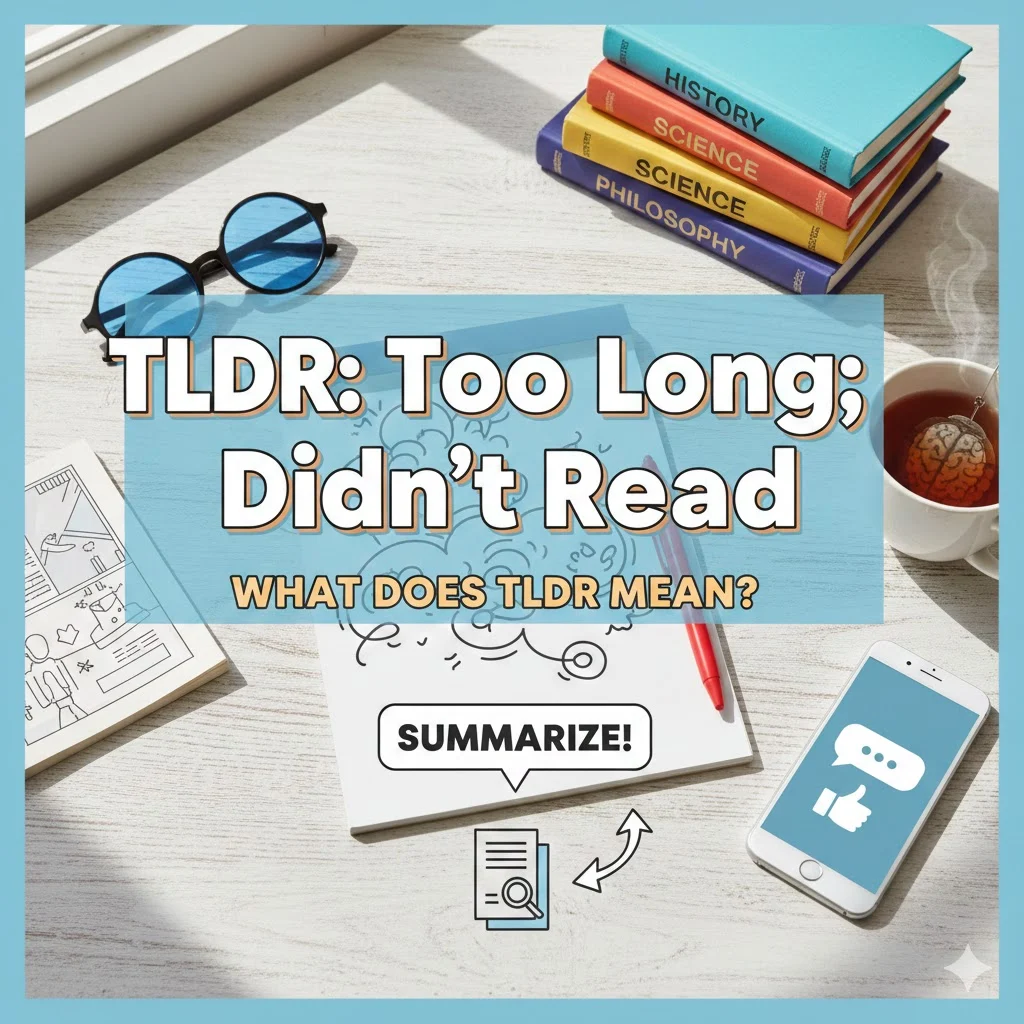
TL;DR stands for “Too Long; Didn’t Read.”
At its core, TL;DR is a concise summary of long posts, messages, or articles. It allows readers to quickly understand the main points without reading the full content.
Here’s what you need to know:
- Full form: Too Long; Didn’t Read
- Purpose: Summarize long content for fast consumption
- Common variations: TLDR, tldr, tl;dr
Example usage:
“TL;DR: Exercise daily, eat balanced, sleep well.”
This instantly tells the reader the key takeaway from a longer health post.
History and Origin of TL;DR
TL;DR originated in early internet forums and email threads. Back in the early 2000s, online communities like Reddit, 4chan, and various discussion forums often had long, detailed posts. Some readers didn’t have time—or patience—to read everything, so TL;DR emerged as a handy shorthand.
Timeline of TL;DR:
| Year | Milestone |
|---|---|
| 2002 | First documented use in online forums |
| 2005 | Popularized on Reddit and 4chan |
| 2010 | Spread to social media, texting, and blogs |
| 2020+ | Widely recognized in professional emails and content writing |
The phrase quickly became part of internet culture, combining humor, convenience, and readability.
TL;DR as Internet Slang
TL;DR is now a key internet abbreviation, commonly used in online communication. It belongs to a larger family of text shorthand, which includes acronyms like BRB (Be Right Back), IMO (In My Opinion), and FWIW (For What It’s Worth).
Key points about TL;DR as slang:
- Casual and humorous in tone
- Signals a summary or condensed message
- Recognized across forums, social media, and texting apps
Unlike formal summaries, TL;DR is informal and conversational. It reflects digital culture and the desire for speed in online reading.
How to Use TL;DR Correctly
Using TL;DR correctly ensures clarity and avoids offending your readers. Its use varies depending on the platform and audience.
In Texts and Chats
When chatting with friends, TL;DR can summarize long messages without losing the main idea.
Example:
Friend: “I just finished reading this massive guide on productivity, but the key points are…”
You: “TL;DR: Focus, plan, take breaks.”
In Emails and Professional Writing
TL;DR can also be used professionally, but it must be polite and strategic. Include it at the top or bottom of emails to summarize content for busy colleagues.
Example professional email TL;DR:
TL;DR: Project deadline extended to Friday. Submit updates by Thursday.
In Social Media
Social media thrives on short attention spans. TL;DR allows users to condense threads, posts, or discussions for faster understanding.
Example on Twitter:
“Spent hours reviewing the new feature rollout. TL;DR: It works, but some bugs remain.”
TL;DR Examples
Seeing TL;DR in action makes it easier to understand. Here are examples from different contexts:
Reddit Thread
Original post: 20-paragraph discussion on climate change policy
Comment: “TL;DR: Reduce emissions, switch to renewable energy, invest in tech.”
Professional Email
Email: 10-paragraph project update
TL;DR line: “Deadline moved to Friday. Submit final report by Thursday.”
Social Media
Facebook post: Long explanation of travel tips
TL;DR: “Pack light, book early, travel safe.”
Casual Text
Friend texts: Story about their day at work
Response: “TL;DR: You survived a crazy day.”
TL;DR vs Summary
Although TL;DR and a summary might seem similar, they serve different purposes.
| Feature | TL;DR | Summary |
|---|---|---|
| Tone | Casual, informal | Formal or neutral |
| Placement | Anywhere in digital communication | Often in academic or professional writing |
| Length | One or two sentences | Can be multiple sentences or paragraphs |
| Purpose | Quick takeaway | Full condensed explanation |
Rule of thumb: Use TL;DR for casual, fast communication, and summaries for professional or formal content.
Why People Use TL;DR
TL;DR has become popular for several reasons:
- Time-saving: Readers get the main point quickly.
- Improves readability: Long posts can be overwhelming; TL;DR makes them digestible.
- Cultural humor: Often adds a playful tone, signaling internet literacy.
- Highlights key points: Helps readers remember important takeaways.
In short, TL;DR caters to our fast-paced, digital lifestyle.
TL;DR Tips and Best Practices
Using TL;DR effectively requires a few simple guidelines:
- Keep it concise: One or two sentences is ideal.
- Be informative: Include essential points, not vague phrases.
- Position wisely: At the beginning or end depending on context.
- Avoid overuse: Using TL;DR in every message can feel lazy.
- Adapt to your audience: Professional vs casual contexts require different tones.
Common Misconceptions About TL;DR
Many people misunderstand TL;DR. Here are some myths debunked:
- “It’s rude.” Not if used respectfully.
- “It replaces proper summaries.” TL;DR is informal; summaries are still needed in formal contexts.
- “Only lazy people use it.” TL;DR is about efficiency, not laziness.
Quote:
“TL;DR is not about skipping content; it’s about making content accessible.” – Digital Communication Expert
TL;DR in Popular Platforms
Reddit popularized TL;DR through user comments on long threads. Users summarize posts to save others time.
Forums
Classic forums used TL;DR to condense discussions spanning multiple pages.
Social Media
Twitter, Facebook, and Instagram use TL;DR in posts and captions for fast engagement.
Emails
Professionals now include TL;DR to highlight key points in lengthy emails.
Related Internet Slang and Abbreviations
TL;DR is part of a larger ecosystem of online shorthand. Some common examples include:
| Abbreviation | Meaning |
|---|---|
| BRB | Be Right Back |
| IMO | In My Opinion |
| FWIW | For What It’s Worth |
| SMH | Shaking My Head |
| TMI | Too Much Information |
Understanding these abbreviations helps you communicate efficiently online.
FAQ About TL;DR
Q: What does TL;DR mean in texting?
A: It’s a short summary of a longer message for quick understanding.
Q: Can TL;DR be used in emails?
A: Yes, but keep it polite and professional.
Q: Is TL;DR rude?
A: Not when used respectfully; it’s a shorthand, not an insult.
Q: TL;DR vs TL;DW — what’s the difference?
A: TL;DW means “Too Long; Didn’t Watch” for videos; TL;DR is for text-based content.
Q: How do you add a TL;DR politely?
A: Place it at the end of your content and summarize the main points clearly.
Conclusion
TL;DR is more than just an abbreviation—it’s a reflection of modern communication habits. It saves time, enhances readability, and adds a touch of humor or personality to digital conversations. Whether you’re texting friends, posting on social media, or writing emails, understanding how and when to use TL;DR makes you a better communicator.
Key Takeaways:
- TL;DR = Too Long; Didn’t Read
- Use it to summarize long content efficiently
- Place strategically depending on context
- Keep it concise, informative, and audience-friendly
- Integrate with other internet slang to communicate digitally
Next time you write a long message, try adding a TL;DR. It might just make your readers’ day a little easier—and you a little cooler online.