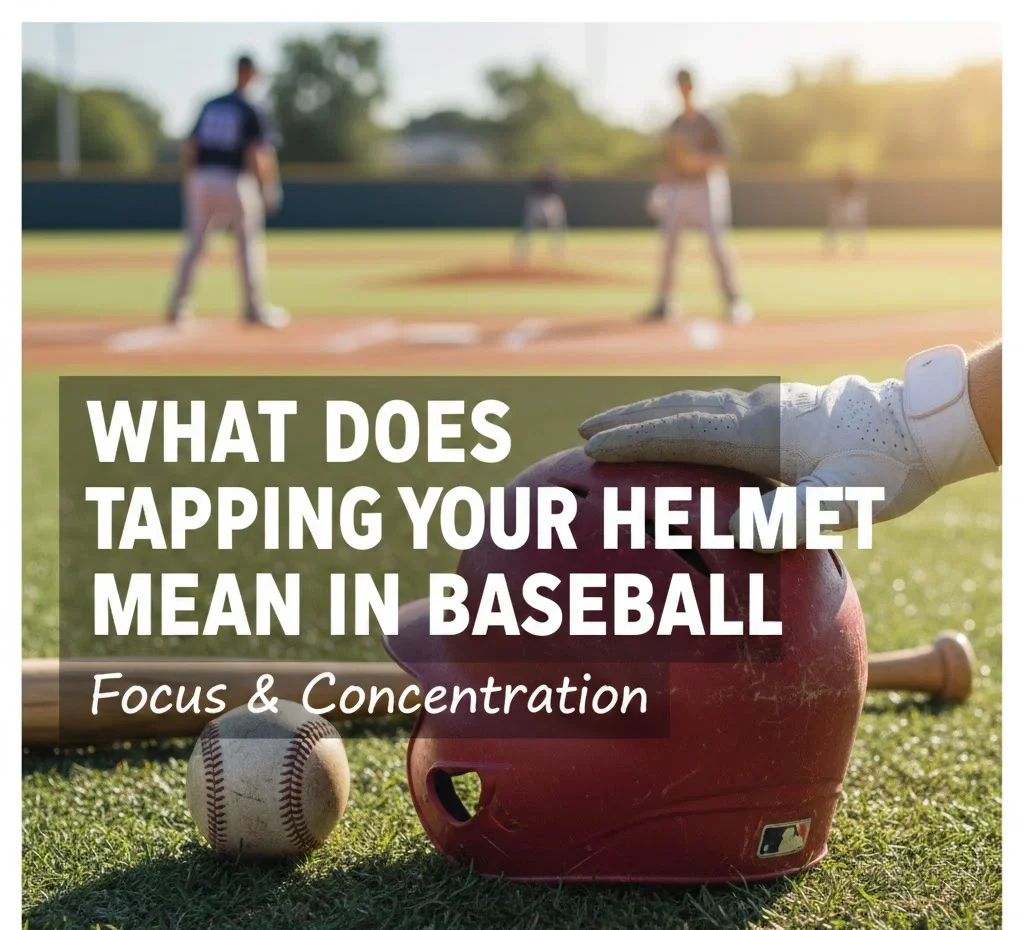
If you’ve ever watched a baseball game—whether it’s MLB, college ball, or Little League—you’ve probably seen players tapping their helmet during a play. For new fans, this gesture can be confusing. Does it mean a sign? A mistake? A message from the coach? Or something else entirely?
In baseball, body gestures are a huge part of communication. Players and coaches use them to share signals, strategies, acknowledgments, warnings, and even celebrations. Tapping the helmet is one of the most commonly used signs on the field.
This article breaks down what tapping your helmet means in baseball, how different players use it, why timing matters, and how to tell the difference between a real sign and a simple acknowledgment. By the end, you’ll understand exactly what’s happening next time you see a player tap their helmet.
Definition & Meaning: What Does Tapping Your Helmet Mean in Baseball?
Tapping the helmet in baseball usually has three common meanings, depending on the situation and who’s doing it:
1. Acknowledging a Coach’s Signal
One of the most common uses is to show the coach:
“I saw your sign. Got it.”
Base runners and batters tap their helmet to confirm they understood the strategy—like bunting, stealing, or taking the next pitch.
Example:
- Coach gives a steal sign.
- Runner taps helmet → confirms the play.
2. Communicating With Teammates
Players sometimes tap their helmet to quickly communicate with teammates, such as:
- “I lost the ball in the lights.”
- “I’m signaling the number of outs.”
- “Watch the pitcher.”
- “Shift your position.”
Outfielders especially do this when adjusting to fly balls.
3. Celebratory Gesture After a Big Play
In modern baseball, helmet taps have become part of celebration culture.
After hitting a double, triple, or home run, players tap their helmet toward the dugout to say:
- “Thank you.”
- “I see you.”
- “Let’s go!”
- “That one’s for the squad.”
Background & History
Helmet tapping evolved as baseball strategies expanded. Historically:
Old-School Baseball (1950s–1980s)
- Coaches used complex signs—hat touches, belt taps, ear pulls.
- Players occasionally tapped their helmet, but it wasn’t as common.
- The tap mostly meant acknowledgment or correction.
1990s–2000s
- As televised baseball grew, teams began hiding signs more carefully.
- Helmet tapping became a subtle, less noticeable acknowledgment gesture.
- Players also started using it during rundown plays, double steals, and bunt coverages.
Modern Era (2010s–Present)
Today, helmet tapping serves multiple roles:
- Celebration: Players tap toward fans, cameras, or teammates.
- Respect: A player may tap their helmet after a teammate makes a great play.
- Hidden Signals: Even with electronic communication now used in some leagues, runners and hitters still use helmet taps.
Social media has helped popularize it—fans see clips, and the gesture becomes recognizable across the baseball world.
Usage in Different Game Contexts
Helmet tapping can mean different things depending on the situation.
1. Batter’s Box
A batter may tap their helmet to:
- Confirm a sign
- Reset after a pitch
- Adjust helmet position
- Indicate they saw a pitch incorrectly
- Acknowledge the dugout after a hit
Example Dialogue:
Coach: Uses signs for bunt.
Batter: Taps helmet once.
Meaning: “Sign received.”
2. Base Running
This is where the gesture shows up most.
Common meanings for runners:
- “Steal sign received”
- “Look for the hit-and-run”
- “Check the outfield shift”
- “Watch the pitcher’s pickoff move”
Some runners tap their helmet as a fake to confuse the defense—part of advanced strategy.
3. Outfield & Infield Communication
Fielders tap their helmets to:
- Signal sun interference
- Show the ball is in sight
- Warn teammates of collision risks
- Share defensive shifts
- Confirm the number of outs
Example:
- Center fielder taps helmet → “Lost in the lights.”
- Left fielder adjusts position accordingly.
4. Dugout to Field Communication
Coaches may use a helmet tap to:
- Cancel a previous sign
- Switch to a new play
- Warn of pickoff attempts
- Reset communication after a balk or timeout
Players tap back to confirm.
Professional Baseball Usage
In MLB, helmet tapping is more structured and intentional.
Why Pros Use It
- Keeps communication quiet.
- Prevents the opposing team from decoding signs.
- Ensures quick acknowledgment—even in loud stadiums.
- Helps players sync defensive strategies.
Examples from Professional Games
- A runner on second taps helmet after receiving the bunt sign.
- A batter taps helmet after a long at-bat to signal he’s locking in.
- A fielder taps helmet to indicate sun interference at day games.
- Hitters tap toward the dugout after hitting a homer.
What NOT to Do in Professional Settings
Players avoid:
- Repeated tapping (could look like fake signaling)
- Tapping during pitcher’s motion (could be misinterpreted)
- Helmet tapping while arguing with umpires (seen as disrespect)
Hidden or Less Obvious Meanings
Helmet tapping can sometimes mean things casual viewers miss.
1. Disguise or Decoy Signals
Teams mix in fake gestures to confuse opponents:
- tapping helmet
- wiping jersey
- flicking fingers
- touching elbow
A helmet tap could be a fake to draw attention away from the real sign.
2. Eye or Vision Adjustment
Sometimes the tap means:
- “I lost the pitch.”
- “I need time.”
- “Something’s in my eye.”
3. Protection Reminder
Coaches sometimes signal players to tap their helmet:
- younger players often forget proper safety positions
- tap reminds them to keep helmets secure
In youth and amateur baseball, safety meaning is more common.
4. Friendly Gesture to Opposing Team
Some players tap their helmet to acknowledge great sportsmanship from opponents—though rare, it’s a positive sign.
Usage in Training, Youth Leagues & Practice Sessions
In Little League, high school, and travel baseball, helmet tapping is simpler and more safety-based.
Common Youth Meanings
- “My helmet is loose.”
- “I can’t see.”
- “Sun is in my eyes.”
- “I’m ready, coach.”
- “Do I swing or bunt?” (player asking for signal)
Coaching Tip
Many youth coaches train players to tap their helmet only after receiving a sign—building good discipline for higher-level baseball.
Comparison With Similar Baseball Signals
| Gesture | Meaning | Who Uses It | Notes |
|---|---|---|---|
| Tapping Helmet | Acknowledgment, communication, celebration | Batters, runners, fielders | Most versatile signal |
| Touching Ear | Sign for bunt, swing, steal | Coaches | Often part of sign sequences |
| Pointing to Eyes | “I see you”, “I’ve got it” | Fielders | Helps coordinate fly-ball catches |
| Tapping Chest | Accountability or ownership | Any player | Means “my bad” or “I got this” |
| Pointing Bat to Dugout | Celebration | Hitters | After extra-base hits or homers |
| Raising Hands Over Head | Timeout or acknowledgment | Any player | Stops play momentarily |
Helmet tapping overlaps with other gestures but remains one of the most commonly recognized signs in the sport.
10 Related Signals & Gestures in Baseball
Here are ten commonly used baseball signals connected to or often mistaken for helmet tapping:
- Helmet Adjust Tap – simple repositioning, not a sign
- Ear Pull – part of coach’s sign sequence
- Cap Bill Touch – often a bunt sign
- Chest Swipe – cancel previous sign
- Finger to Helmet Side – “I can’t hear you”
- Two Taps Helmet – repeat sign request
- Tap + Point to Dugout – celebration
- Helmet Brim Swipe – fake bunt
- Tap + Look to Third Base – steal verification
- Tap + Open Palm – sun interference warning
These gestures help make baseball one of the most communication-heavy sports.
How Players Respond to Helmet Tapping
Responses change depending on who initiated the gesture.
1. Batter Responding to Coach
- Quick head nod
- One tap back
- Eye contact confirmation
2. Runner Responding to Teammates
- Gives thumbs-up
- Adjusts lead-off position
- Prepares for steal or hit-and-run
3. Teammates Responding to Celebratory Tap
- Raise helmets
- Clap from the dugout
- Exchange short chants or hand signals
4. Safety-Related Response
- Umpire may pause play
- Teammate may offer help adjusting helmet
- Coach may call timeout
Regional, Age-Level & Cultural Differences
The meaning of tapping your helmet can vary slightly depending on the level of baseball.
United States
- Mostly acknowledgment + celebration
- Highly used in MLB and college games
Japan
- More formal and disciplined
- Often used to signal focus, not celebration
- Japanese players tend to bow slightly while tapping helmet
Latin America (Dominican Republic, Venezuela, Cuba)
- Used as a stronger celebratory gesture
- Common after home runs and big hits
Youth Baseball Worldwide
- Mostly indicates safety issues or asking for signs
Understanding these small differences helps fans interpret the action correctly across leagues.
FAQs
1. Is tapping your helmet always a signal in baseball?
No. It can be confirmation, communication, or celebration depending on context.
2. Do MLB players use helmet taps as real signs?
Sometimes yes—mainly to acknowledge the coach’s instructions.
3. Can a player tap their helmet to ask for a time-out?
Indirectly—umpires mainly rely on hand or voice signals for time-outs, not helmet taps.
4. Why do players tap their helmet after a home run?
It’s a celebratory gesture acknowledging teammates or fans.
5. Is helmet tapping required?
No, but it’s widely used at all levels of baseball for communication.
Conclusion
Tapping your helmet in baseball is a simple gesture with many layers of meaning. It can signal acknowledgment, communicate with teammates, highlight safety concerns, or serve as a fun celebration after a big play. Whether you’re watching MLB, college ball, or youth leagues, recognizing this gesture helps you better understand strategy and teamwork on the field. Now that you know what tapping the helmet means, you’ll see the game with clearer eyes and deeper appreciation. Keep watching for these small details—they’re what make baseball such a strategic and exciting sport.