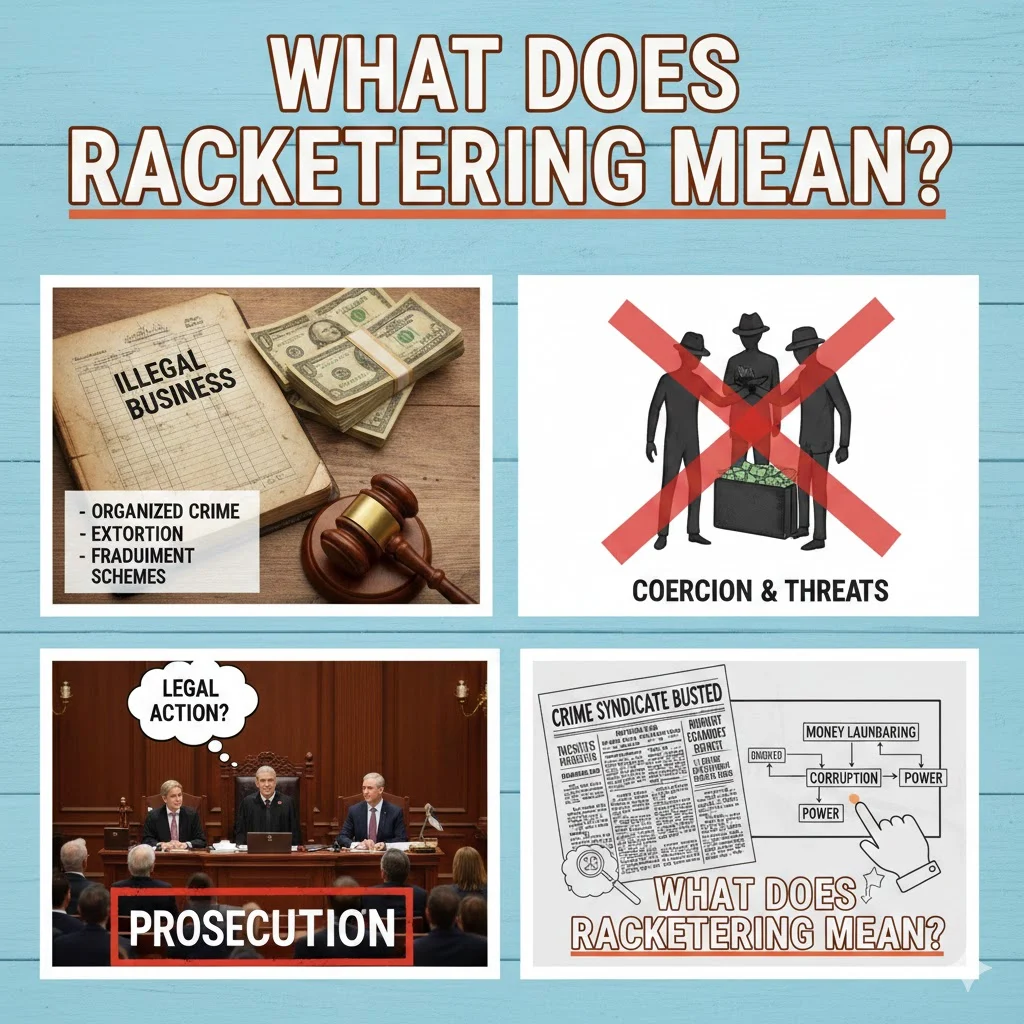
If you’ve ever watched crime documentaries, heard the term in news reports, or seen it used online, you’ve probably wondered: “What does racketeering mean?”
The word sounds complicated, but the idea is simple once you break it down. Teens, young adults, and professionals see this term in legal stories, politics, movies, and social media discussions. Understanding it helps you decode headlines, follow crime-related conversations, and spot how criminal organizations operate.
In this guide, we’ll explain the meaning of racketeering, where the word came from, how it’s used today, and why it matters in both real life and online communities.
Definition & Meaning of Racketeering
Racketeering refers to organized illegal activities carried out to make money, often through schemes, threats, or fraud.
It usually involves groups, not individuals, and requires a pattern of repeated criminal acts.
Common forms of racketeering:
- Extortion (threatening someone for money)
- Fraud (fake schemes to steal money)
- Money laundering
- Bribery
- Illegal gambling
- Drug trafficking
- Human trafficking
- Cybercrime rings
Simple Explanation:
Racketeering = a group planning and repeating crimes to make steady profit.
Example in conversation:
Mia: “Why was that politician arrested?”
Leo: “Racketeering. They say his group was running money scams for years.”
Key points:
- It’s a serious criminal charge.
- Laws like RICO (Racketeer Influenced and Corrupt Organizations Act) are designed to stop it.
- It usually involves long-term schemes, not one-time actions.
Background & History of Racketeering
The term racketeering became popular in the early 1900s when authorities fought mafia and mob operations. Criminal groups were running “rackets,” which were fake or illegal businesses designed to steal money or control communities.
Historical roots:
- 1920s–1950s: Mob-run protection rackets, illegal alcohol sales, gambling rings.
- 1970: The U.S. passed the RICO Act to target criminal organizations.
- Modern era: Cybercrime, online scams, digital extortion, cryptocurrency laundering.
Why the word “racket”?
It originally meant a dishonest scheme pretending to offer a service while actually creating the very problem it “solved.”
Example: A gang charging “protection money” from shop owners—a problem they created themselves.
Today, racketeering covers both old-school organized crime and modern digital crime networks.
Usage in Different Contexts
The term appears in many places:
1. News & Media
Used when discussing criminal charges, political scandals, or mafia-related stories.
“Several executives were indicted for racketeering.”
2. Legal Documents
Courts use the word to describe a pattern of criminal activity under laws like RICO.
3. Social Media
People may use it casually or jokingly:
“Charging $15 for a coffee should be considered racketeering 😭”
4. Entertainment
Movies, crime series, and documentaries use the term to explain mafia operations, cartel behavior, or corruption networks.
Table: Formal vs Informal Use
| Context | Meaning | Tone |
|---|---|---|
| Legal news | Real criminal activity | Serious |
| Politics | Corruption, bribery | Critical |
| Social media | Exaggeration/humor | Casual |
| Education | Crime study | Neutral |
Professional Communication
In workplaces—especially in legal, political, banking, or journalism fields—racketeering is used in its official sense.
When to use it professionally:
- Discussing crime cases
- Analyzing economic or political corruption
- Explaining legal charges or court decisions
Avoid using it casually around colleagues unless it’s clearly a joke. Serious legal terms can easily be misunderstood.
Good alternatives for professional tone:
- “Illegal business activity”
- “Fraudulent operation”
- “Organized criminal conduct”
Hidden or Offensive Meanings
“Racketeering” itself is not offensive, but using it recklessly or jokingly can offend people—especially in serious discussions.
Risky:
“Your company’s fees feel like racketeering.”
This can sound legally accusatory.
Safe:
“These online scams remind me of racketeering operations.”
Clear academic context.
Tone matters. Always consider who you’re talking to.
Usage in Online Communities & Dating Apps
People rarely use “racketeering” literally on dating apps or casual platforms. Instead, it appears in humor, memes, and exaggeration.
Examples:
- “$200 for dinner? That’s racketeering 😭”
- “Apps charging for reads and likes… pure racketeering.”
Tips:
- Use it lightly and jokingly.
- Avoid using it in serious conversations—you might sound dramatic.
- Don’t accuse real people of crimes online.
Comparison with Similar Terms
| Term | Meaning | Seriousness | Notes |
|---|---|---|---|
| Racketeering | Organized criminal activity | Very high | Long-term schemes |
| Fraud | Deceiving for money | High | Can be single or repeated act |
| Extortion | Threatening someone for money | High | Often part of racketeering |
| Scam | Small or one-time fraud | Medium | Common online |
| Corruption | Abuse of power for gain | High | Often political |
Key insight:
Racketeering is broader and covers many crimes under one umbrella.
10 Terms Related to Racketeering
- RICO – The law used to prosecute racketeering.
- Extortion – Threat-based money demands.
- Money laundering – Hiding illegal money.
- Fraud ring – Group-based scams.
- Cartel – Organized crime group.
- Mob operations – Traditional mafia activities.
- Bribery scheme – Buying influence.
- Protection racket – Forcing payment for “safety.”
- Ponzi scheme – Fake investment system.
- Cybercrime network – Online crime organization.
How to Respond When Someone Mentions Racketeering
Curious:
- “What exactly happened?”
- “Can you explain the charges?”
Professional:
- “That sounds like a serious allegation.”
- “Is there an official report?”
Casual:
- “Whoa, that’s wild.”
- “Hope no one got hurt.”
Avoid:
- Making accusations without facts.
- Using the term jokingly in serious contexts.
Regional & Cultural Differences
- U.S.: The term is strongly linked to the RICO Act and mafia-related cases.
- Europe: Often used to describe corruption, money laundering, and cross-border crime.
- Asia: More connected to cybercrime networks and illegal gambling rings.
- Latin America: Sometimes refers to cartel or gang operations.
Meaning stays consistent, but the types of crimes associated with racketeering vary by region.
FAQs
Q1: Is racketeering always a federal crime?
No, but many cases fall under federal law due to organized or multi-state activity.
Q2: Does racketeering mean the same as fraud?
Not exactly—fraud can be part of racketeering, but racketeering is broader.
Q3: Who can be charged with racketeering?
Anyone involved in a criminal organization or repeated crime pattern.
Q4: Can cybercrime be racketeering?
Yes—modern racketeering includes online scams and digital extortion.
Q5: Is racketeering only related to the mafia?
No. It now covers gangs, corruption networks, cartels, and online groups.
Conclusion
Racketeering is a serious term used to describe organized, repeated criminal activity carried out for profit. It includes crimes like fraud, bribery, money laundering, extortion, and cybercrime, often involving groups rather than individuals. Understanding the meaning of racketeering helps you read news reports, follow legal discussions, and recognize how criminal organizations operate today. Whether used in headlines, documentaries, or memes, context makes the difference. While the term occasionally appears in casual online jokes, it still carries heavy legal weight. Use it carefully, stay informed, and always look for verified information when discussing real cases.