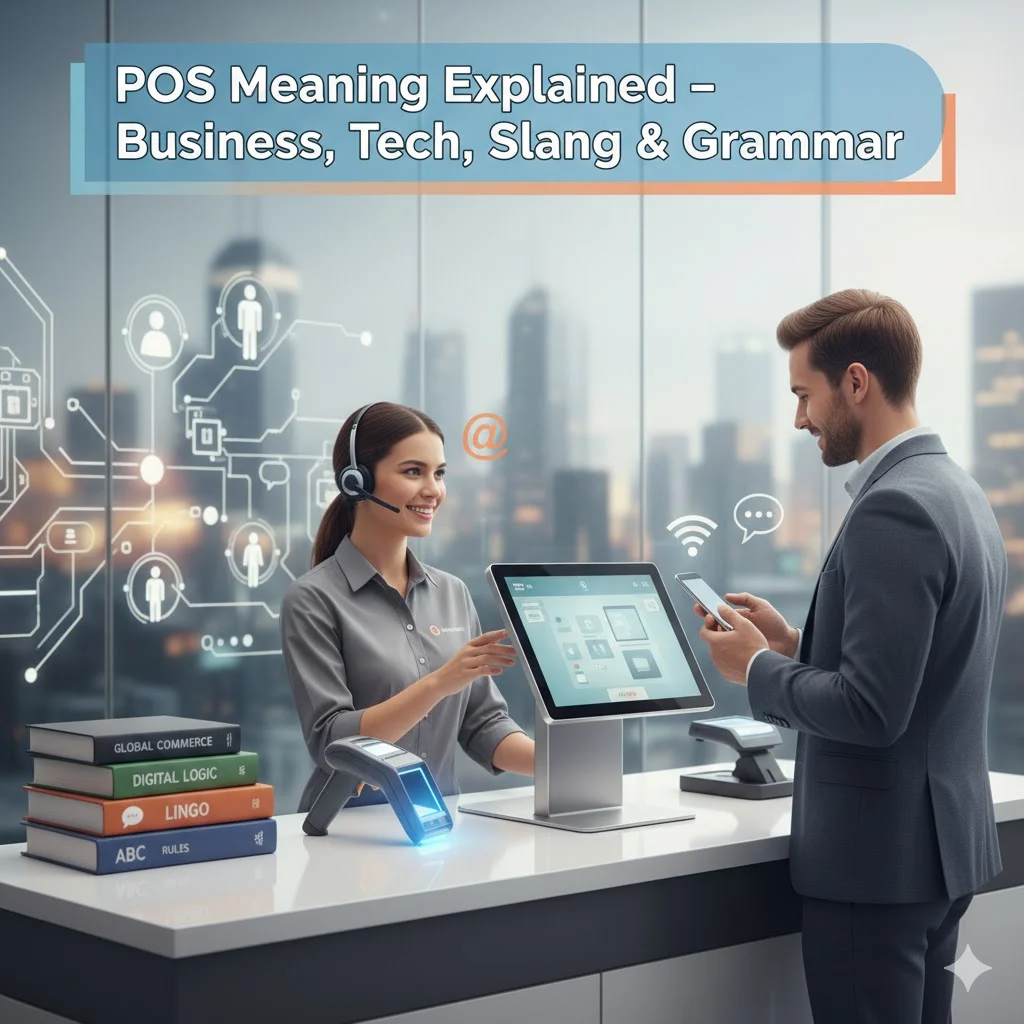
If you’ve ever come across the abbreviation POS, you may have wondered what it actually means. Depending on the context, POS meaning can vary widely—from business and technology to casual slang, texting, or grammar.
In this comprehensive guide, we will explain POS in business (Point of Sale), POS systems in technology, POS slang meaning, and POS in grammar. You’ll also learn how to tell which meaning applies in any situation, complete with real-life examples.
By the end of this article, you’ll fully understand the POS definition and how to use it correctly in conversation, text messages, or professional settings.
1. POS in Business: Point of Sale
What Is a Point of Sale?
In the business world, POS stands for Point of Sale. It refers to the location, hardware, or software where a customer completes a purchase. This can include a cash register, checkout counter, or a modern POS system integrated with inventory and payment processing.
Example:
“The clothing store upgraded its POS system to handle more customers during peak hours.”
Key Features of a POS System
Modern POS systems go far beyond just processing payments. Businesses rely on them for efficiency, accuracy, and customer satisfaction. Typical features include:
- Payment processing – Accepts cash, debit/credit cards, and mobile payments.
- Inventory tracking – Automatically updates stock levels with every sale.
- Sales reporting – Provides analytics and insights for better business decisions.
- Customer management – Tracks customer purchases and loyalty programs.
- Employee management – Schedules and tracks employee performance.
Example:
“The café’s POS software alerts staff when items are low in stock.”
Benefits of Using a POS System
- Faster Transactions – Reduces checkout time and increases customer satisfaction.
- Error Reduction – Automated calculations minimize human mistakes.
- Data-Driven Decisions – Sales and inventory analytics help optimize business strategy.
- Customer Experience – Loyalty programs and personalized service enhance satisfaction.
2. POS Systems in Technology
Understanding POS Software
In the tech industry, POS software integrates hardware like barcode scanners, receipt printers, and touch-screen terminals to streamline business operations.
Types of POS Systems:
- Traditional POS: Physical terminals in stores with on-site servers.
- Mobile POS (mPOS): Smartphones or tablets used to process sales on the go.
- Cloud-Based POS: Systems that store data online, accessible from anywhere, ideal for multi-location businesses.
Example:
“Our POS software updates inventory automatically after each transaction, making stock management effortless.”
Why Businesses Choose Modern POS Technology
- Efficiency – Faster checkouts and fewer errors.
- Accessibility – Cloud POS allows managers to monitor sales remotely.
- Integration – Connects with e-commerce platforms for unified sales tracking.
- Analytics – Provides insights on customer behavior and product performance.
3. POS in Slang: A Casual or Offensive Term
POS as “Piece of S***”
In informal conversation, texting, or online chats, POS can mean “Piece of S*”**, which is a derogatory term used to describe something considered bad, worthless, or frustrating.
Example:
“This old laptop is a total POS; it crashes every day.”
Important Note:
This usage is offensive and should be avoided in professional or polite contexts. It is most commonly used in online forums, casual texting, or social media.
4. POS in Grammar: Part of Speech
Understanding POS in English Grammar
In English grammar, POS refers to Part of Speech, which classifies words based on their function in a sentence.
Common Parts of Speech Include:
- Nouns – Represent people, places, things, or ideas.
- Verbs – Indicate actions or states.
- Adjectives – Describe nouns.
- Adverbs – Modify verbs, adjectives, or other adverbs.
- Pronouns – Replace nouns.
- Prepositions – Show relationships between nouns and other words.
- Conjunctions – Connect words or clauses.
- Interjections – Express emotions or reactions.
Example:
“In the sentence ‘The cat sleeps on the sofa,’ ‘cat’ is a noun, and ‘sleeps’ is a verb.”
5. POS in Messaging: Parent Over Shoulder
In online chatting, POS can also humorously mean Parent Over Shoulder, indicating someone’s parent is watching their messages.
Example:
“BRB, POS!”
(Translation: Be right back, parent over my shoulder.)
This usage is mostly used by teens and young adults in informal messaging.
6. How to Determine Which POS Meaning Applies
The key to understanding POS meaning is context. Here’s a quick guide:
| Context | Meaning | Example |
|---|---|---|
| Business/Retail | Point of Sale | “The shop installed a new POS system.” |
| Technology | POS system/software | “This POS software tracks inventory automatically.” |
| Casual/Slang | Piece of S*** | “My old phone is a POS.” |
| Grammar | Part of Speech | “Identify the POS of each word in the sentence.” |
| Messaging | Parent Over Shoulder | “POS! Be careful what you text.” |
7. Real-Life Examples of POS Usage
Retail/Business:
“The store’s POS system now accepts mobile payments and cards, speeding up the checkout process.”
Technology:
“Cloud POS software allows managers to monitor sales from anywhere in the world.”
Casual Slang:
“This old car is a POS; it broke down again today.”
Grammar:
“In the sentence ‘She runs fast,’ ‘She’ is a pronoun and ‘runs’ is a verb.”
Messaging:
“POS! Can’t text freely, my mom is looking over my shoulder.”
8. Benefits of Understanding POS
Knowing the various POS meanings helps you:
- Communicate clearly in different contexts
- Avoid misunderstandings in business, tech, or casual settings
- Recognize slang and informal uses online
- Enhance knowledge of grammar and English structure
- Understand retail and tech systems if you are in business
9. Frequently Asked Questions (FAQs)
Q1: What does POS mean in business?
A: In business, POS stands for Point of Sale, the location or system where sales are completed.
Q2: Is POS always negative in slang?
A: Yes, when used as “Piece of S*”**, POS expresses frustration or negativity.
Q3: Can POS mean Part of Speech?
A: Absolutely! In grammar, POS refers to the function of words in a sentence.
Q4: How do I know which POS meaning applies?
A: Look at the context—business = Point of Sale, tech = POS system/software, casual chat = slang, grammar = Part of Speech.
Q5: Are POS systems necessary for modern businesses?
A: While not mandatory, POS systems greatly improve efficiency, accuracy, and customer experience.
Keywords used: What does POS mean, POS definition, POS meaning in business, POS meaning in texting.
10. Conclusion
POS meaning varies widely across business, technology, grammar, and casual slang. By understanding the context, you can quickly determine the correct interpretation.
- In business, it’s a Point of Sale system.
- In technology, it’s software/hardware managing sales.
- In slang, it can be offensive as “Piece of S***.”
- In grammar, it’s a Part of Speech.
- In messaging, it may mean Parent Over Shoulder.
Understanding these meanings allows you to communicate clearly, whether you are texting, chatting online, or working in a business environment.
Top Related Terms / Abbreviations
- POS system – Retail checkout software/hardware
- Point of Sale meaning – Business definition
- POS terminal – Payment processing device
- Mobile POS – Tablet or smartphone-based system
- POS slang meaning – Informal/online usage
- Part of Speech – Grammar term