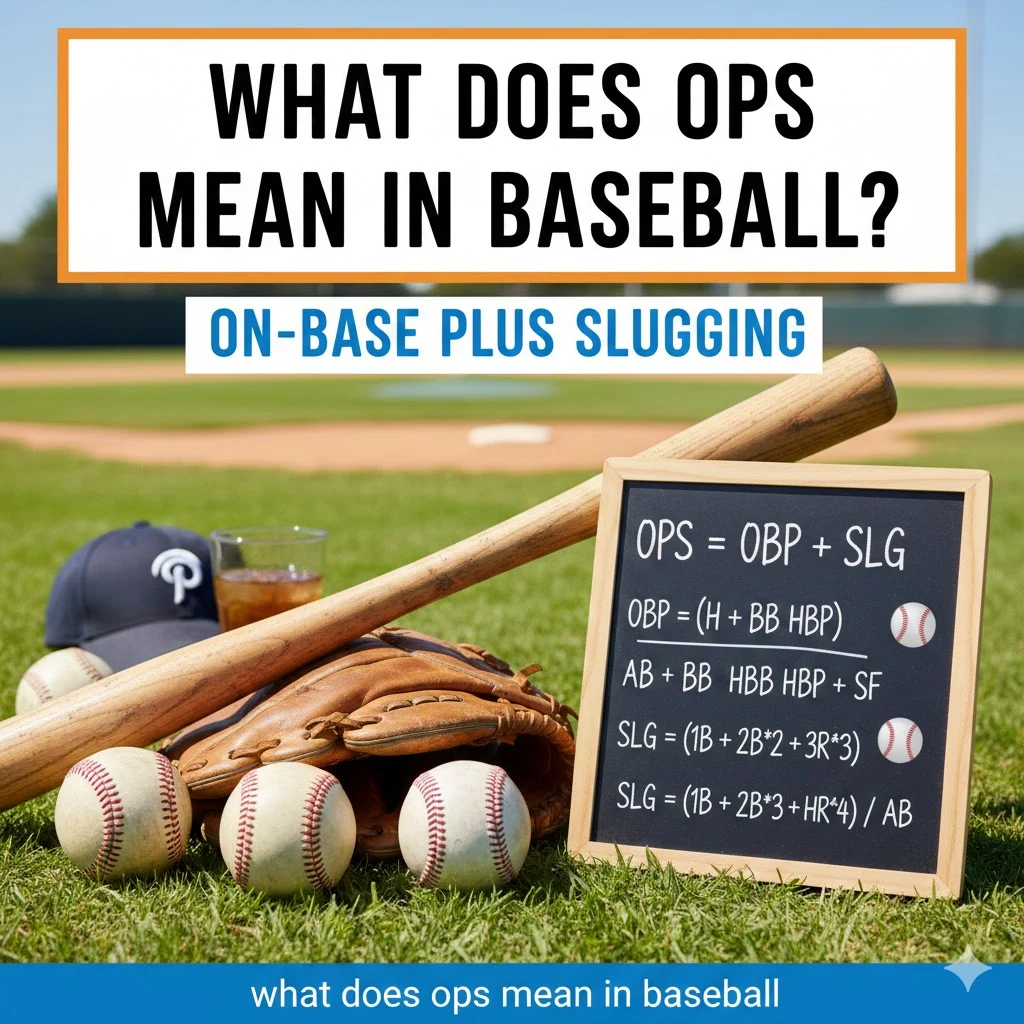
If you’re new to baseball or trying to understand modern analytics, you’ve probably seen the stat OPS. Fans talk about it. Coaches track it. Analysts love it. But what does OPS mean in baseball, and why does it matter so much?
OPS is now one of the most popular stats used in MLB broadcasts, scoreboards, fantasy leagues, and online baseball discussions. It helps you understand a player’s true offensive value in a fast and simple way.
This guide breaks everything down in plain English—no advanced math, no confusing jargon—just clear explanations and real examples.
Definition & Meaning of OPS
OPS stands for On-base Plus Slugging.
It combines two major hitting statistics:
- On-Base Percentage (OBP) → how often a player gets on base
- Slugging Percentage (SLG) → how much power a player hits with
OPS = OBP + SLG
This single stat shows how well a player reaches base and hits for power. That’s why it’s one of the best quick indicators of offensive ability.
Quick Example
If a player has:
- OBP: .360
- SLG: .500
Then:
OPS = .360 + .500 = .860
That’s considered very good in baseball.
Why Players Use It
- Makes comparing hitters simple
- Highlights both contact AND power
- Used heavily in broadcasts, analytics, scouting, and fantasy baseball
Background & History of OPS
OPS became popular during the rise of modern baseball analytics, especially in the 1990s and early 2000s. Sabermetricians wanted a way to measure offensive value beyond traditional stats like batting average.
Key Milestones
- Bill James and early stat analysts looked for smarter metrics.
- OPS gained traction because it was simple, accurate, and predictive.
- By the early 2000s, MLB teams, broadcasters, and fantasy leagues adopted it widely.
OPS also gained fame through:
- Moneyball (Oakland A’s)
- Online baseball communities
- Sports journalism and televised analytics
Today, OPS appears on scoreboards, player cards, scouting reports, and advanced stat sheets.
Usage in Baseball, Stats, and Analytics
OPS is used everywhere baseball stats appear:
MLB & Professional Baseball
- Compare hitters quickly
- Identify high-value offensive players
- Evaluate sluggers, contact hitters, and all-around threats
Fantasy Baseball
- OPS leagues reward players who walk and hit for power
- Helps pick undervalued players with strong OBP
Youth & Amateur Baseball
- Coaches use OPS to highlight developing hitters
- Simplifies player evaluation without deep analytics
Table: OPS by Performance Level
| OPS Range | Performance Level |
|---|---|
| .900+ | Elite hitter |
| .800–.899 | Very good |
| .700–.799 | Average |
| .600–.699 | Below average |
| Below .600 | Poor hitter |
Professional Communication (Coaches, Scouts, Analysts)
In professional settings—reports, scouting notes, and player evaluations—OPS is standard terminology.
When It’s Appropriate
- Player scouting reports
- Game analysis
- Statistical breakdowns
- Fantasy baseball discussions
When It’s Inappropriate
- Explaining stats to beginners without clarification
- Media interviews with general audiences
- Youth coaching without simplifying first
Better alternatives:
- “His on-base skills and power hitting are excellent.”
- “He gets on base often and hits for extra bases.”
Hidden or Misunderstood Meanings
OPS is usually clear, but misunderstandings happen:
Common Misinterpretations
- Some think OPS is a single calculation (it’s two stats added).
- Some assume OPS = batting average (wrong).
- Others confuse it with OPS+, an advanced adjusted stat.
Safe Clarification Examples
- “OPS shows both on-base ability and power.”
- “OPS+ compares players to league average.”
Risky Example
- “His OPS is good” without explaining what makes it good or poor.
Usage in Online Communities & Baseball Forums
Baseball fans, fantasy players, and analysts use OPS everywhere online:
Where OPS Shows Up
- Reddit baseball threads
- Fantasy baseball subreddits
- Twitter/X baseball debates
- MLB fan pages
- Discord sports servers
Example Conversation
Fan 1: “Is he worth drafting?”
Fan 2: “Definitely. His OPS was .850 last season—that’s solid.”
Using OPS online shows you understand modern baseball analytics.
Comparison with Similar Baseball Stats
| Stat | Meaning | What It Measures | Complexity |
|---|---|---|---|
| OPS | OBP + SLG | Overall offensive value | Easy |
| OBP | On-Base Percentage | Getting on base | Easy |
| SLG | Slugging Percentage | Power hitting | Easy |
| OPS+ | Adjusted OPS | Ballpark- & era-adjusted performance | Medium |
| wOBA | Weighted On-Base Average | True value of hits & walks | Advanced |
Key takeaway:
OPS is simple yet powerful—perfect for beginners and experts.
10 Baseball Terms & Acronyms Related to OPS
- OBP – On-Base Percentage
- SLG – Slugging Percentage
- OPS+ – OPS adjusted for league and park factors
- ISO – Isolated Power
- BABIP – Batting Average on Balls In Play
- wOBA – Weighted On-Base Average
- WAR – Wins Above Replacement
- AVG – Batting Average
- RBI – Runs Batted In
- XBH – Extra-Base Hits
Each of these connects to evaluating hitters the way OPS does.
How to Interpret or Respond to OPS Stats
Casual Responses
- “Wow, his OPS is fire this year.”
- “Anything above .900 is crazy good.”
Analytical Responses
- “His high OBP boosts his OPS more than his power.”
- “Great slugging numbers are driving the OPS spike.”
Fantasy Baseball Responses
- “Draft him—his OPS keeps trending up.”
Professional Responses
- “His OPS reflects balanced on-base and power production.”
Regional & Cultural Differences
OPS stays mostly consistent across regions, but how people talk about it varies.
United States
- Used from MLB to college to youth baseball
- Common on TV broadcasts
Latin America
- Popular among professional leagues
- Spanish commentators explain OPS more often for fans
Japan (NPB)
- OPS is widely used in pro baseball but less common among casual fans
Online Communities
- OPS discussions often include advanced stats like OPS+ and wOBA
FAQs
Q1: What does OPS stand for?
On-Base Plus Slugging.
Q2: Is OPS important in baseball?
Yes, it’s one of the best quick indicators of offensive performance.
Q3: What is a good OPS?
Anything above .800 is considered strong.
Q4: Is OPS better than batting average?
Yes—OPS shows both getting on base and hitting for power.
Q5: What is OPS+?
A version of OPS adjusted for ballpark and league averages.
Conclusion
OPS is one of baseball’s most useful and beginner-friendly stats. It blends a player’s ability to reach base with their power at the plate, giving fans a simple yet accurate view of offensive value. Whether you’re watching MLB, joining fantasy baseball, or learning the game, understanding OPS helps you compare players quickly and confidently. It’s widely used in broadcasts, scouting reports, and online discussions because it’s easy to calculate and meaningful in every level of baseball. With OPS, you can follow games more clearly and appreciate the strengths of today’s top hitters.