If you’ve ever read a research paper, academic essay, or legal document, you’ve probably seen the term “et al” scattered throughout. At first glance, it might seem confusing or like some mysterious Latin phrase reserved for scholars. But in reality, et al is one of the most useful shortcuts in writing when citing multiple authors or contributors.
In this guide, we’ll break down exactly what et al means, its history, correct usage, and practical examples. By the end, you’ll confidently know when and how to use it in any academic, legal, or professional setting.
What Does “Et Al” Mean?
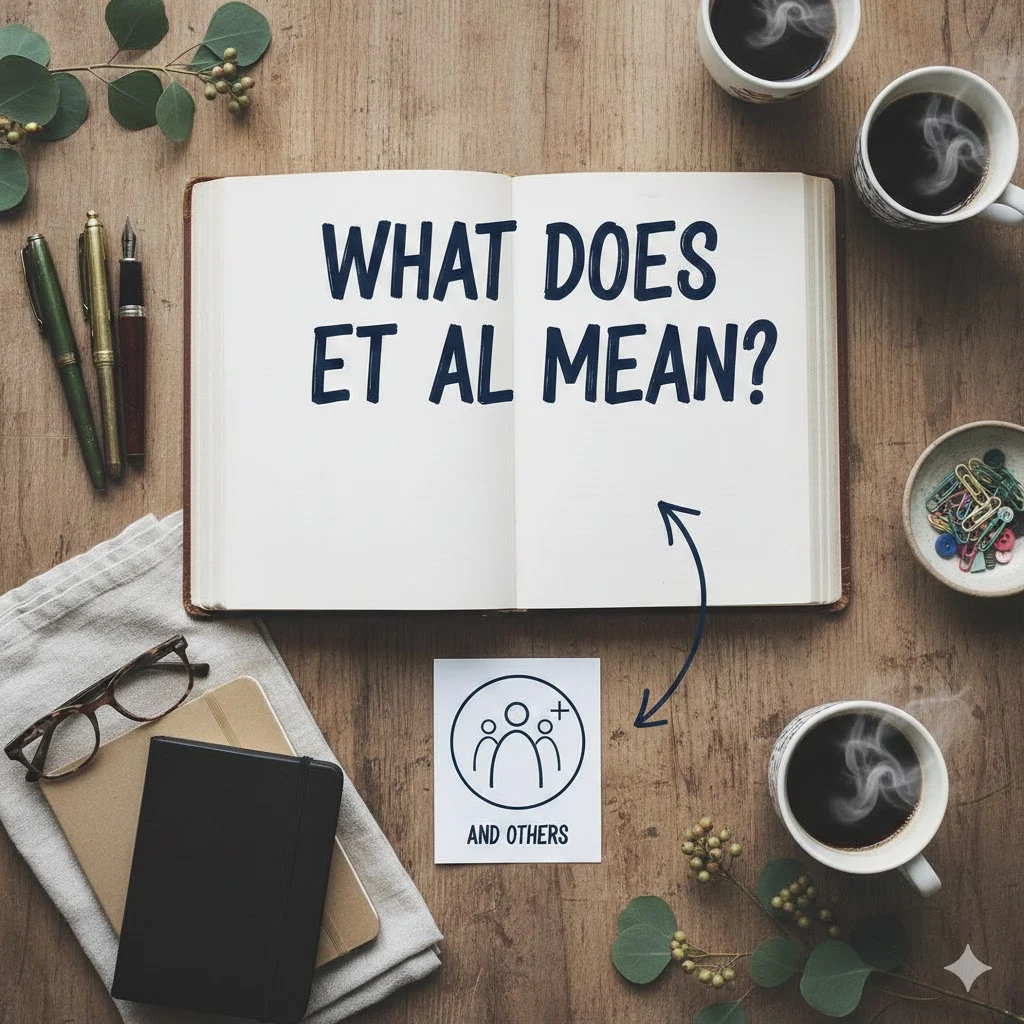
Et al is a Latin abbreviation derived from et alia, which literally translates to “and others”. In writing, it’s commonly used to refer to multiple authors or contributors without listing each name individually.
Quick Facts:
- Latin Origin: et alia (and others)
- Common Usage: Academic papers, research articles, legal documents
- Plural Use: Refers to more than one person
- Abbreviation: Always written as et al. (note the period after “al”)
For example, in a citation like:
Smith, Johnson, et al. (2022) found that…
The “et al.” signals that Smith and Johnson are the first authors, but there are additional contributors included in the study.
Etymology and Origin
Understanding the origin of et al can help you appreciate why it’s still widely used today.
- Latin Roots:
- “et” = and
- “alia” or “alii” = others
- Historical Use: Latin abbreviations were common in scholarly writing during the Middle Ages and Renaissance. They helped keep manuscripts concise.
- Modern Adoption: Today, et al appears in APA, MLA, Harvard, and Chicago style references, especially when citing multiple authors in research papers or journal articles.
When and Why to Use “Et Al”
Using et al isn’t arbitrary; it serves specific purposes in professional writing:
- Academic Writing: Instead of listing five or ten authors in every in-text citation, et al simplifies the process.
- Legal Documents: Shorthand for multiple parties or cases without repeating long names.
- Scientific Papers: Saves space in reference lists, especially for studies with multiple collaborators.
- Essays and Projects: Helps maintain clarity without overwhelming readers with a long string of names.
Pro Tip: Et al isn’t a substitute for proper credit—it’s a concise tool. Always make sure full authors are listed in the bibliography or reference list.
Correct Usage Rules
Using et al correctly is crucial to avoid confusion or mistakes. Here’s a detailed breakdown:
Punctuation
- Always write et al. with a period after “al”.
- Do not add a period after “et.”
- Example:
- ✅ Johnson, Smith, et al. (2023)
- ❌ Johnson, Smith, et. al (incorrect)
Capitalization
- Use lowercase unless starting a sentence.
- Example:
- ✅ The study by Smith et al. (2020) is comprehensive.
- ❌ The study by Smith Et Al. (2020) is comprehensive.
Singular vs Plural Context
- Plural: Always refers to multiple contributors.
- Singular: Rarely used; “et al” by definition implies more than one.
Grammar Integration
- Et al functions like a noun phrase within sentences.
- You cannot treat it as a verb or adjective.
Table: Common Grammar Rules for Et Al
| Rule | Correct Example | Incorrect Example |
|---|---|---|
| Period placement | Smith et al. (2021) | Smith et al (2021) |
| Capitalization | Smith et al. wrote the report | Smith Et Al. wrote the report |
| Singular usage | Refers to multiple authors | Refers to single author |
| Sentence position | According to Smith et al., research… | According to et al Smith, research… |
Et Al in Different Citation Styles
The rules for et al vary slightly depending on citation style. Let’s explore the most common ones:
APA Style
- Use et al for in-text citations with three or more authors.
- Example:
- First citation: (Smith, Johnson, & Lee, 2020)
- Subsequent citations: (Smith et al., 2020)
- Reference List: Include all authors (up to 20 in APA 7th edition).
MLA Style
- Use et al when citing more than two authors.
- Example:
- Works Cited: Smith, John, et al. The Science of Learning. 2021.
- MLA favors brevity in text but lists full author names in the bibliography.
Harvard Style
- Author-date format: first author + et al.
- Example:
- In-text: (Smith et al., 2020)
- Reference list: Smith, J., Johnson, L., Brown, K., et al., 2020. Research Methods.
Chicago Style
- Footnotes may use et al for three or more authors.
- Example:
-
- John Smith et al., Modern Science (New York: Academic Press, 2020), 45.
-
Pro Tip: Always check your style guide for limits on the number of authors before using et al.
Common Mistakes to Avoid
Even experienced writers sometimes misuse et al. Here are the most frequent pitfalls:
- Using et al for a single author.
- Forgetting the period after “al”.
- Overusing et al, making citations unclear.
- Placing et al incorrectly in reference lists or sentences.
- Mixing citation styles within one document.
Quick Tip: When in doubt, list all authors in the first mention and use et al for subsequent citations.
Examples of “Et Al” in Writing
Seeing et al in context clarifies its proper use.
Research Paper Example
Recent studies (Smith, Johnson, et al., 2022) show a strong correlation between sleep patterns and cognitive performance.
Essay Bibliography Example (MLA)
Smith, John, et al. Modern Approaches to Learning. New York: Academic Press, 2021.
Legal Document Example
In Brown, Johnson, et al. vs. State of California, the court ruled in favor of the plaintiffs.
Scientific Journal Reference Example
Wilson, A., Chen, B., Patel, S., et al. (2020). Effects of Diet on Heart Health. Journal of Medicine, 55(4), 200–215.
Table: Correct vs Incorrect Usage in Citations
| Context | Correct Example | Incorrect Example |
|---|---|---|
| Research paper in-text | Smith et al. (2021) found… | Smith, et al (2021) found… |
| Bibliography/Works Cited | Smith, John, et al. Title. 2021. | Smith, John, et. al Title. 2021. |
| Legal documents | Brown, Johnson, et al. vs. State | Brown, Johnson et al vs. State |
| Scientific paper references | Wilson et al. (2020) | Wilson et al (2020) |
Et Al Variations and Related Terms
Et al has several related forms and variations:
- Full forms:
- et alia (neuter plural) – general “and others”
- et alii (masculine plural) – specific to male authors
- et aliae (feminine plural) – specific to female authors
- And others vs et al: “And others” is less formal and rarely used in professional citations.
- Other Latin abbreviations in academic writing: cf., i.e., e.g., viz.
Tips for Using “Et Al” Effectively
Here are practical tips to master et al in writing:
- Use for clarity, not laziness: Only abbreviate long author lists.
- Check your citation style: APA, MLA, and Harvard have different rules.
- Consistency is key: Use et al consistently throughout your document.
- Proofread citations: Ensure proper punctuation, capitalization, and placement.
- Create a quick reference table: Helps remember when and how to apply et al.
Summary / Key Takeaways
- Meaning: Et al = “and others,” used to cite multiple contributors.
- Origin: Latin abbreviation still widely used in modern writing.
- Correct Usage: Always write et al., lowercase unless at sentence start, and place properly in sentences.
- Citation Styles: APA, MLA, Harvard, and Chicago have specific rules.
- Mistakes to Avoid: Single author misuse, missing period, overuse, and style mixing.
By understanding and applying these rules, you’ll write more concise, professional, and polished papers, whether academic, legal, or scientific.
Frequently Asked Questions (FAQ)
What does et al stand for in research?
Et al stands for et alia, meaning “and others.” It refers to additional authors beyond the first listed.
When should I use et al in an essay?
Use et al when citing a source with three or more authors, depending on your citation style.
Is et al singular or plural?
It is plural, always referring to multiple people.
Can et al be used in legal writing?
Yes, especially when referencing cases involving multiple parties.
Do I need a period after “et al”?
Yes, always write et al. with a period after “al.”
Interactive Learning Table: Quick Reference for Et Al Usage
| Style | In-Text Citation Example | Reference/Bibliography Example | When to Use Et Al |
|---|---|---|---|
| APA | Smith et al. (2020) | Smith, J., Johnson, L., Lee, K., et al. (2020) | 3+ authors in text |
| MLA | Smith et al. | Smith, John, et al. Title. 2021. | 3+ authors |
| Harvard | Smith et al., 2020 | Smith, J., Johnson, L., Brown, K., et al., 2020 | 3+ authors in text |
| Chicago | John Smith et al., Title | John Smith et al., Title (New York: Academic Press, 2020) | 3+ authors in footnotes |
By following this guide, you’ll never second-guess what et al means or how to use it. This tiny Latin abbreviation can streamline your writing, save space, and make your citations look professional—if you use it correctly.