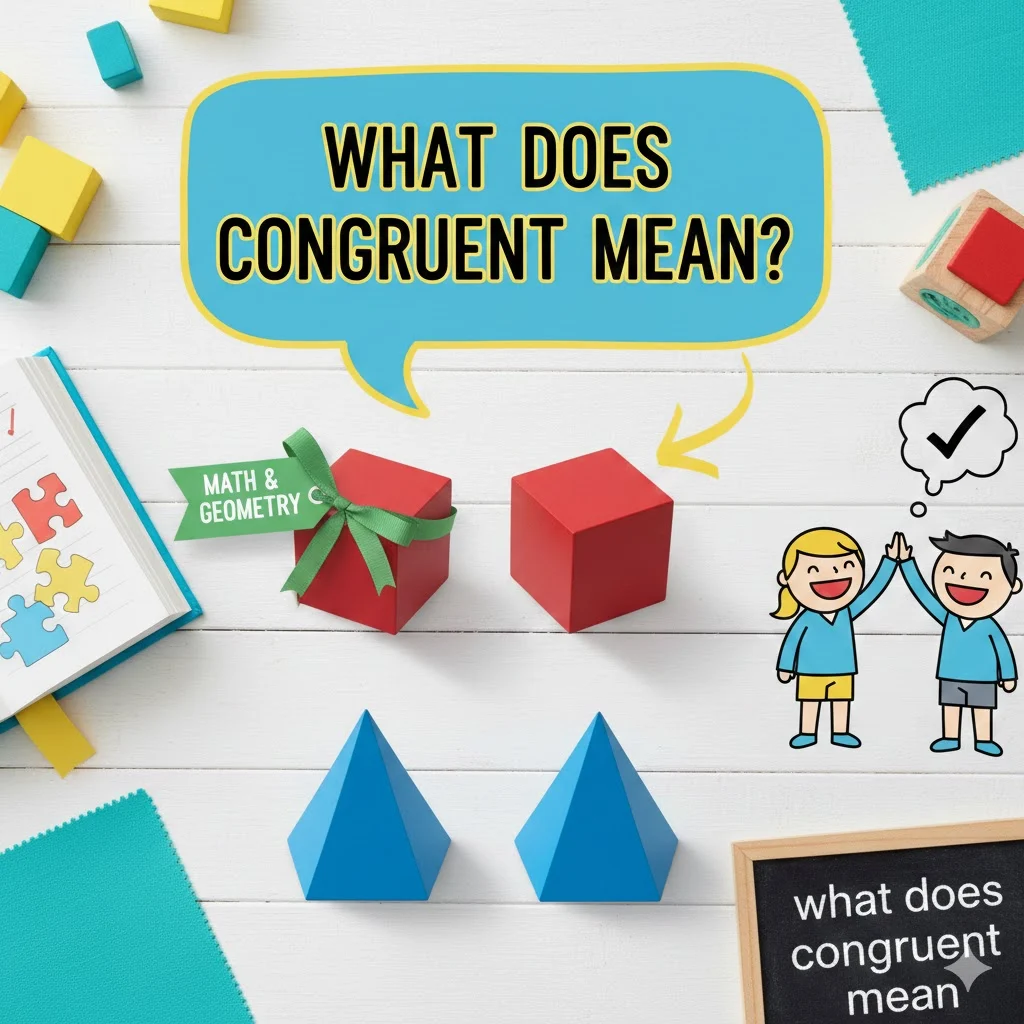
Understanding what does congruent mean is essential for students, teachers, and anyone interested in mathematics or geometry. The concept of congruency is a cornerstone in geometry, shaping the way we compare shapes, angles, and figures.
Whether you are dealing with triangles in class, designing a building, or noticing patterns in everyday life, congruency helps us recognize exact matches and maintain precise measurements.
In this article, we’ll break down everything you need to know about congruent shapes, congruent triangles, congruent angles, congruency rules, and practical applications. You’ll also find examples, tables, exercises, and tips to master this concept easily.
What Is Congruent? — Core Definition
At its simplest, congruent means that two objects are identical in size and shape. When two shapes are congruent, you can place one on top of the other, and they will match perfectly.
Mathematical Definition
In mathematics, the formal definition of congruent is:
Two geometric figures are congruent if they have the same shape and size. Their corresponding sides and angles are exactly equal.
For example:
- Two triangles with equal side lengths and angles are congruent triangles.
- Two line segments of the same length are congruent line segments.
- Two angles measuring 60° each are congruent angles.
Symbol for Congruent: The symbol used to denote congruency is ≅.
Example:
- △ABC ≅ △DEF means triangle ABC is congruent to triangle DEF.
Congruent vs Equal
A common question is: what is the difference between congruent and equal?
| Term | Definition | Example |
|---|---|---|
| Congruent | Same shape and size; can be figures, shapes, or angles | Two triangles with equal sides and angles |
| Equal | Same value or measurement; usually numbers or quantities | Two angles measuring 90° are equal |
While congruent often deals with geometry, equal is used in both math and everyday contexts.
Congruency in Geometry
Congruency in geometry is about comparing shapes, angles, and figures to see if they match exactly. This concept helps us solve complex problems and understand spatial relationships.
Congruent Shapes
Congruent shapes are geometric figures with:
- All corresponding sides equal
- All corresponding angles equal
Examples include:
- Congruent triangles: △ABC ≅ △DEF
- Congruent rectangles: Both rectangles have the same length and width
- Congruent squares: Same side lengths
Congruent Angles
Congruent angles have equal measures, no matter their orientation or size of the figure. For example:
- Angle ∠A = ∠B = 50°
- These angles are congruent and can exist in triangles, polygons, or separate geometric figures.
Congruent Figures
Congruent figures include any shape where all corresponding sides and angles are equal:
- Triangles
- Quadrilaterals (squares, rectangles, rhombuses)
- Polygons
Properties of Congruent Figures
Understanding the properties of congruent figures allows you to quickly identify matching shapes and solve geometric problems.
Key Properties
- Equal Corresponding Sides: Every side in one figure has a matching side in the other figure.
- Equal Corresponding Angles: All angles in one shape match the corresponding angles in the other shape.
- Exact Overlay: If you place one figure on top of the other, it aligns perfectly.
Example: Congruent Triangles
| Triangle | Sides (cm) | Angles (°) |
|---|---|---|
| △ABC | AB=5, BC=6, AC=7 | ∠A=50, ∠B=60, ∠C=70 |
| △DEF | DE=5, EF=6, DF=7 | ∠D=50, ∠E=60, ∠F=70 |
Since all sides and angles match, △ABC ≅ △DEF.
Congruence Criteria and Theorems
To determine if triangles are congruent, mathematicians use congruence rules or theorems.
Main Congruence Theorems
| Rule | Meaning | Example |
|---|---|---|
| SSS (Side-Side-Side) | All three sides of one triangle equal all three sides of another | △ABC ≅ △DEF if AB=DE, BC=EF, AC=DF |
| SAS (Side-Angle-Side) | Two sides and the included angle match | △ABC ≅ △DEF if AB=DE, ∠B=∠E, BC=EF |
| ASA (Angle-Side-Angle) | Two angles and the included side match | △ABC ≅ △DEF if ∠A=∠D, AB=DE, ∠B=∠E |
| RHS (Right-angle-Hypotenuse-Side) | Right triangles with equal hypotenuse and one side | Useful only for right triangles |
These rules help identify congruent triangles quickly and accurately.
How to Identify Congruent Shapes
Identifying congruent shapes requires careful observation. Here are practical steps:
- Compare Sides: Check if all corresponding sides are equal.
- Compare Angles: Ensure all corresponding angles are equal.
- Overlay Test: Imagine placing one shape over the other to see if it aligns.
- Use Congruence Theorems: Apply SSS, SAS, ASA, or RHS rules.
- Check Orientation: Congruent shapes may be rotated, flipped, or mirrored but still match exactly.
Example in Real Life
- Tiles on a floor: all square tiles are congruent.
- Playing cards: identical in size and shape.
- Windows in a building: congruent rectangles ensure symmetry.
Congruent vs Similar Shapes
A common confusion in geometry is the difference between congruent and similar shapes.
Key Differences
| Feature | Congruent Shapes | Similar Shapes |
|---|---|---|
| Size | Same size | Can be different sizes |
| Shape | Same shape | Same shape |
| Angles | Equal angles | Equal angles |
| Sides | Equal corresponding sides | Proportional sides |
| Symbol | ≅ | ∼ |
Example:
- Two squares of size 5 cm × 5 cm are congruent.
- Two squares of size 5 cm × 5 cm and 10 cm × 10 cm are similar, not congruent.
Real-Life Applications of Congruency
Congruency isn’t just for math class. It appears everywhere in everyday life.
Everyday Examples
- Architecture & Engineering: Ensuring symmetry and structural integrity.
- Tiling & Flooring: Congruent tiles fit perfectly without gaps.
- Art & Design: Patterns and repeating motifs require congruent shapes.
- Clothing & Fashion: Matching fabric pieces for sewing or tailoring.
Quote: “Geometry is the art of correct reasoning on correct diagrams.” — George Pólya
Why Congruent Shapes Are Important
- Helps maintain accuracy in measurements.
- Essential for designing mechanical and architectural structures.
- Provides a foundation for advanced math concepts, like transformations and symmetry.
Congruent Math Problems and Practice
Practicing congruency problems strengthens understanding. Here are some examples and exercises.
Problem 1: Identify Congruent Triangles
Given: △XYZ with sides XY=5 cm, YZ=6 cm, XZ=7 cm
△PQR with sides PQ=5 cm, QR=6 cm, PR=7 cm
Solution:
- All three sides are equal → SSS rule applies.
- Therefore, △XYZ ≅ △PQR
Problem 2: Find Congruent Angles
Given: △ABC and △DEF, ∠A=60°, ∠B=50°, ∠C=70°
Task: Identify congruent angles.
Solution:
- ∠A ≅ ∠D, ∠B ≅ ∠E, ∠C ≅ ∠F
Problem 3: Use ASA Rule
Given: △GHI with ∠G=40°, ∠H=60°, GH=8 cm
△JKL with ∠J=40°, ∠K=60°, JK=8 cm
Solution:
- Two angles and the included side match → ASA rule
- △GHI ≅ △JKL
Practice Exercises for Students
- Draw two congruent triangles using any congruence rule.
- Identify congruent angles in a quadrilateral.
- Spot congruent objects in your classroom or home.
Summary / Key Takeaways
- Congruent means shapes, figures, or angles are identical in size and shape.
- Congruent shapes and triangles must have equal sides and angles.
- Use congruence theorems like SSS, SAS, ASA, and RHS to identify matching triangles.
- Congruent vs similar: congruent shapes are the same size, similar shapes can be proportionally scaled.
- Congruency appears in daily life, from tiles to windows to design patterns.
Mastering congruency makes geometry intuitive and practical for real-world applications.
FAQs About Congruency
What does congruent mean in geometry?
- It means two shapes or figures are exactly equal in size and shape, with matching sides and angles.
How do you know if two shapes are congruent?
- Compare sides, angles, use the overlay method, or apply congruence rules like SSS, SAS, ASA.
Are congruent angles always equal?
- Yes, congruent angles always have the same measure, regardless of their orientation.
Can congruent shapes be rotated or flipped?
- Absolutely. Rotation, reflection, or mirroring does not affect congruency.
Tables and Diagrams Summary
| Shape Type | Congruency Check | Example |
|---|---|---|
| Triangle | Sides and angles equal | △ABC ≅ △DEF |
| Rectangle | Length and width equal | 2 rectangles 5×10 cm |
| Square | All sides equal, angles 90° | 5×5 cm squares |
| Quadrilateral | Corresponding sides and angles equal | Parallelograms, rhombuses |
This article provides a complete guide to understanding, identifying, and applying congruency in mathematics and real life. By mastering these concepts, students, teachers, and enthusiasts can solve geometric problems more confidently and spot patterns in everyday objects.
Conclusion
Understanding what does congruent mean is more than memorizing a definition—it’s about recognizing patterns, shapes, and angles in both mathematics and everyday life. Congruent figures have identical sides and angles, and by using rules like SSS, SAS, ASA, and RHS, you can quickly determine congruency in triangles and other polygons.
Congruency also extends beyond the classroom, appearing in architecture, design, art, and engineering. Knowing how to identify congruent shapes helps you solve geometry problems, create accurate designs, and appreciate symmetry in the world around you.
By practicing exercises, observing real-life examples, and mastering congruence theorems, you’ll gain confidence in geometry and build a strong foundation for advanced mathematical concepts. Remember, congruent shapes may rotate or flip, but their exact size and shape never change—this consistency is what makes congruency so essential.