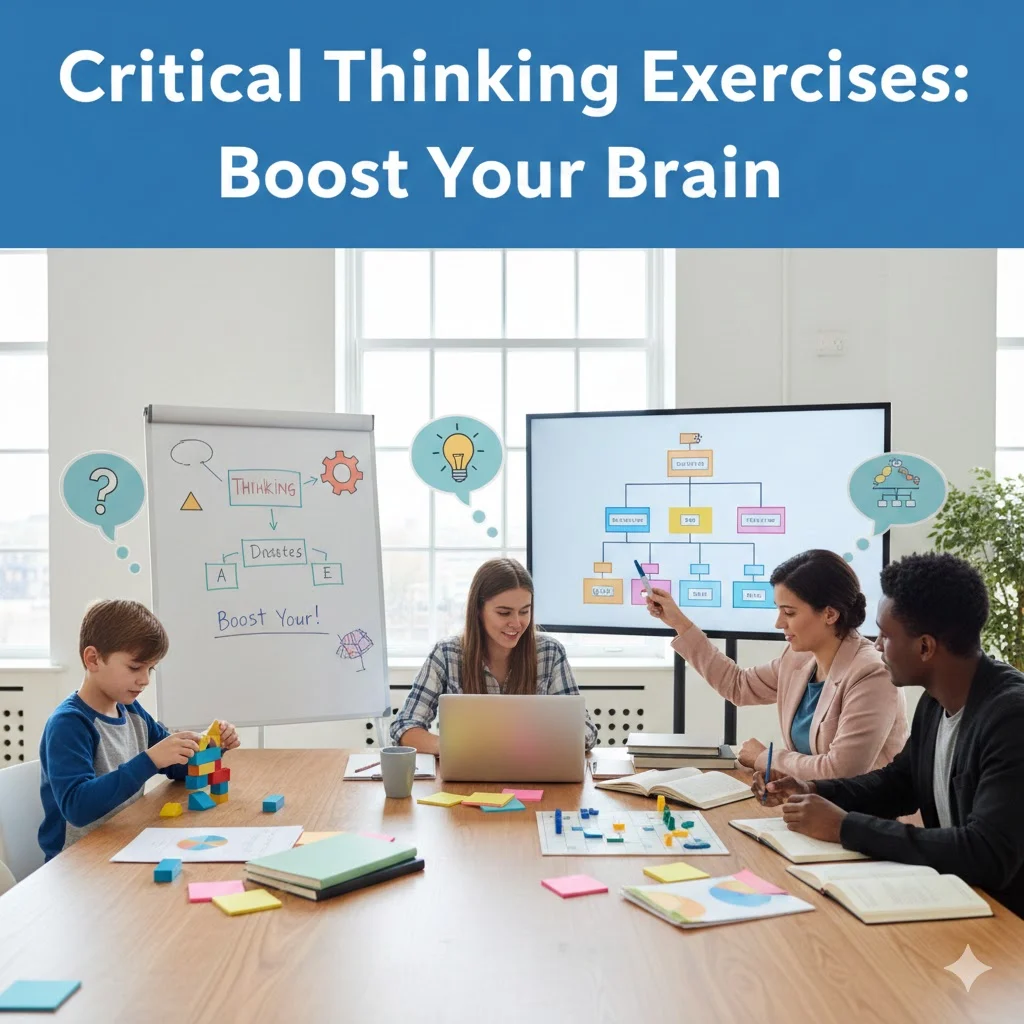
Critical thinking is more than just a buzzword. It’s the cornerstone of intelligent decision-making, problem-solving, and meaningful analysis in everyday life. Whether you are a student aiming to excel academically, a professional striving for sharper workplace skills, or a parent nurturing a child’s cognitive growth, practicing critical thinking exercises can transform your mind.
In this guide, we will explore practical, effective, and fun critical thinking exercises for all ages. You’ll find detailed examples, tables, strategies, and step-by-step exercises to enhance your reasoning, logic, and problem-solving skills.
What is Critical Thinking?
Critical thinking is the ability to analyze information, evaluate arguments, and make reasoned decisions. Unlike passive thinking, it involves questioning assumptions, examining evidence, and considering alternative perspectives.
At its core, critical thinking is built on three essential skills:
- Analysis: Breaking information into parts to understand it better.
- Evaluation: Assessing the credibility, relevance, and logic of ideas.
- Reasoning: Drawing conclusions based on evidence, logic, and systematic thought.
Why Critical Thinking Matters
Critical thinking isn’t just an academic skill. It plays a vital role in:
- Education: Helps students solve complex problems, write essays with clarity, and approach projects strategically.
- Workplace: Enables professionals to make smarter decisions, innovate, and analyze risks effectively.
- Daily Life: Improves decision-making in personal finances, relationships, and health.
Quote:
“The essence of critical thinking is to question assumptions and think beyond the obvious.”
Benefits of Practicing Critical Thinking Exercises
Engaging in critical thinking activities regularly can:
- Improve problem-solving abilities and decision-making accuracy.
- Enhance logical reasoning and analytical skills.
- Boost creativity by combining critical evaluation with imaginative thought.
- Develop cognitive flexibility, enabling you to adapt to new situations.
- Build confidence in decision-making, reducing impulsive choices.
Types of Critical Thinking Exercises
Critical thinking exercises come in various formats, depending on your objectives. Here are the main categories:
| Exercise Type | Purpose | Examples |
|---|---|---|
| Logic Exercises | Develop reasoning and analytical skills | Puzzles, riddles, Sudoku |
| Problem-Solving Exercises | Improve decision-making and solution strategies | Case studies, scenario analysis |
| Reasoning Exercises | Enhance evaluation and judgment skills | Debate exercises, logic games |
| Interactive Exercises | Encourage collaboration and dynamic thinking | Group discussions, online exercises |
| Daily Mind Challenges | Build routine mental fitness | Brain teasers, reflective journaling |
Critical Thinking Exercises for Different Audiences
Students
Students can benefit enormously from critical thinking exercises for students. Exercises at this stage strengthen reasoning, logic, and comprehension skills.
Effective exercises include:
- Logic Puzzles: Sudoku, crosswords, or pattern recognition games.
- Scenario Analysis: Solve hypothetical situations with multiple possible outcomes.
- Debates: Encourage forming arguments, analyzing opposing viewpoints, and defending opinions.
- Case Studies: Analyze real-world situations, identify problems, and propose solutions.
- Reflection Journals: Record daily experiences and question underlying assumptions.
Printable Worksheet Idea:
A table where students can write:
| Problem | Assumptions | Possible Solutions | Best Solution | Reasoning |
|---|
Tip: Encourage students to spend at least 15–20 minutes daily on a critical thinking exercise.
Adults
For adults, critical thinking exercises for adults often focus on workplace, daily life, and strategic thinking.
Practical exercises include:
- Scenario-Based Drills: Analyze workplace dilemmas or project challenges.
- Decision-Making Exercises: Evaluate pros and cons before making choices.
- Brainstorming with Logic: Combine creative ideas with analytical evaluation.
- Mind Mapping: Organize thoughts and identify connections between concepts.
- Critical Reading: Analyze articles, news, or reports to identify biases and assumptions.
Daily Routine Table for Adults:
| Time | Exercise | Duration | Objective |
|---|---|---|---|
| Morning | Brain teaser | 10 min | Wake up analytical thinking |
| Midday | Case study review | 15 min | Evaluate workplace scenarios |
| Evening | Reflective journaling | 10 min | Analyze daily decisions |
Fact: Adults who engage in daily critical thinking exercises report a 20–30% improvement in problem-solving efficiency within three months.
Kids
Early cognitive development can be significantly enhanced through critical thinking exercises for kids.
Fun exercises include:
- Story-Based Problem Solving: Create scenarios and ask children to find solutions.
- Riddles and Puzzles: Enhance logic and pattern recognition.
- Board Games: Games like chess or strategy-based games teach foresight and planning.
- Interactive Group Activities: Encourage teamwork, reasoning, and perspective-taking.
Example Table: Fun Daily Critical Thinking Routine for Kids
| Activity | Age Group | Duration | Skill Developed |
|---|---|---|---|
| Story-based puzzles | 5–8 | 10 min | Problem-solving |
| Riddles | 7–12 | 15 min | Logical reasoning |
| Strategy board games | 10–14 | 20 min | Planning and foresight |
| Debate or discussion | 12–15 | 15 min | Argumentation and evaluation |
Quote:
“Children learn to think critically not when they memorize, but when they question and explore.”
Popular Critical Thinking Exercise Formats
Logical Puzzles and Riddles
- Strengthen analytical skills by requiring step-by-step reasoning.
- Examples: Sudoku, riddles, pattern completion games, math puzzles.
Scenario-Based Questions
- Present a situation with multiple possible outcomes.
- Encourage weighing evidence and evaluating solutions.
- Example: “Your company must choose between two marketing strategies. How do you decide?”
Mind Mapping & Brainstorming
- Combine creative thinking with structured analysis.
- Organize ideas, identify patterns, and plan steps effectively.
Group Debates and Discussions
- Develop argumentation, perspective-taking, and evaluation skills.
- Useful for students, adults, and collaborative work environments.
Online Exercises
- Platforms offering interactive exercises simulate real-life problem-solving scenarios.
- Can include timed quizzes, virtual logic games, and collaborative challenges.
Creating Your Own Daily Critical Thinking Routine
Consistency is key. A daily routine ensures steady improvement.
Step-by-step guide:
- Allocate Time: 15–20 minutes daily for mental exercises.
- Mix Exercise Types: Combine logic, reasoning, and creative thinking.
- Reflect: End each session by reviewing what you learned or could improve.
- Increase Complexity Gradually: Start with simple exercises, then move to advanced ones.
- Record Progress: Track improvements in decision-making, problem-solving, and analysis.
Daily Routine Example:
| Time | Exercise | Skill Focus |
|---|---|---|
| Morning | Brain teaser | Logic |
| Afternoon | Case scenario | Decision-making |
| Evening | Reflection journal | Reasoning |
Tip: Use simple daily exercises like analyzing a news article or planning a small project to keep the brain engaged.
Measuring Your Progress
Assessing progress helps identify strengths and weaknesses.
Methods include:
- Reflection Journals: Note challenges, reasoning errors, and solutions.
- Peer Feedback: Discuss solutions with others to spot blind spots.
- Timed Puzzles: Measure accuracy and speed.
- Problem Logs: Track daily problems and how efficiently you solved them.
Table Example: Tracking Critical Thinking Progress
| Date | Exercise | Difficulty | Success Rate | Notes |
|---|---|---|---|---|
| Jan 10 | Sudoku | Medium | 85% | Faster than last week |
| Jan 11 | Case Study | High | 70% | Need more evidence analysis |
| Jan 12 | Debate | Medium | 90% | Strong arguments but weak rebuttals |
Tools, Worksheets, and Resources
Even without external links, you can create a personal toolkit for critical thinking:
- Printable Worksheets: Daily logic and reasoning exercises.
- Mind Maps: Sketch ideas to visualize thought processes.
- Brain Teaser Collections: Riddles and puzzles in a notebook.
- Scenario Libraries: Create your own real-world problem scenarios for practice.
- Daily Reflection Journal: Track learning and mistakes for long-term improvement.
FAQs About Critical Thinking Exercises
What are the best critical thinking exercises for adults?
Scenario analysis, case studies, reflective journaling, and logic puzzles yield the best results for adults.
Can kids improve reasoning skills with games?
Absolutely. Strategy games, riddles, and interactive problem-solving activities enhance cognitive flexibility.
How long should I practice daily to see improvement?
A consistent 15–20 minutes daily is sufficient. Noticeable improvement occurs within 4–8 weeks.
Are online critical thinking exercises effective?
Yes, they offer dynamic problem-solving scenarios and real-time feedback.
How do critical thinking exercises help in problem-solving?
They train your mind to analyze, evaluate, and reason systematically, reducing impulsive decisions.
Conclusion
Critical thinking exercises are not optional—they are essential for anyone who wants to excel academically, professionally, or personally. By engaging in daily practice, exploring logical puzzles, analyzing scenarios, and reflecting on decisions, you can sharpen your reasoning, improve problem-solving, and think with clarity.
Start small, stay consistent, and gradually increase complexity. With these exercises, you’re not just thinking—you’re thinking critically, effectively, and strategically.
Remember: The mind is like a muscle. The more you challenge it, the stronger and more agile it becomes.